Popular War Movies - Page 459

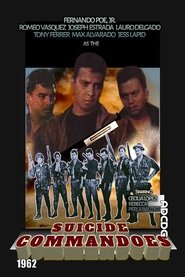
Suicide Commandoes
1962
Suicide Commandoes
1962
The story line, although in fiction, was set in the last days of the Second World War in the Philippines, particularly the Bessang Pass in the island of Luzon. The combined Filipino and American military forces are having a hard time in defeating the Japanese Imperial Army. Because of this situation, many military personnel and civilians on the side of the Filipino and Americans caught between the opposing forces are dying in large numbers everyday. Equipment and logistics in large quantities are also lost during the same time. The top brass of the United States Armed Forces in the Far East (USAFFE) decided to select six Filipinos from various several guerrilla units under its command to execute a mission codenamed “Mission X-310”:Over There
1917
Over There
1917
When Ermis Held His Breath: The Battle of Crete
2021
A COSMOTE TV production that looks back at the historical events that marked the famous battle of Crete, when the "Operation Mercury" of the Nazi forces met unexpected and heroic resistance from the inhabitants of the island.Hanoi: Winter of '46
1999
Hanoi: Winter of '46
1999
star 8Toward the end of 1946, residents from all walks of Hanoi struggle to avoid—and eventually accept—the possibility of a full-blown war.The Surrender of Tournavos
1897
star 5Three military men, seen inside a fortification, are firing on an unseen enemy force. The call for reinforcements but ladders appear signalling the enemy is about to overrun this position.Druhovia
1980
Druhovia
1980
Above the Best
2019
Above the Best
2019
star 5.7Army Aviators say they fly "above the best" see the lengths these heroes will go to, to protect the soldiers on the ground, and each other during intense combat in the most dangerous places on Earth.The Coward
1962
The Coward
1962
star 6.8In a remote Slovak village in the closing days of World War II, a schoolteacher and his young wife find a wounded Russian parachutist in their front yard just as the Germans are coming in to occupy their village. As his wife readily becomes involved with anti-Nazi partisans, the schoolteacher collaborates with the Germans in fear.The Honour of the Tribe
1993
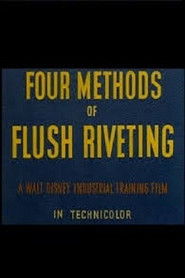
star 10Like every year in Zitouna, a bear handler passes by. With his creature, he comes to challenge the small community. And like every year, it is Slimane El Mabrouk who defends the honor of the tribe. But this time, he dies, leaving two orphans, Omar and Ourida. Robbed of their inheritance, the children will grow up alone. The years pass, the French army settles in, and with it, the war. Mysteriously, one day, after the murder of a French legionnaire, Omar disappears into the bush, while his sister dies in childbirth. Omar will return to the village, much later, once independence has been acquired, as a representative of power and with this enigmatic formula: "You must know that the Revolution has not forgotten you". Personal revenge? Sincere desire to bring progress and modernity? ... The inhabitants of Zitouna, upset in their ancestral way of life, will not be long in having an answer to their questions.Four Methods of Flush Riveting
1942
star 3.7Flush riveting is a way of connecting two pieces of sheet metal together, using rivets whose heads do not protrude above the surface of the metal. In aircraft construction, a flush rivet reduces drag, thus increasing aircraft performance. This World War II-era Walt Disney industrial-training film teaches four methods of flush-riveting aircraft aluminum sheet metal: the Countersink method, the Double Dimple method, the Pre-Dimple method, and the Combination Pre-Dimple and Countersink method. The choice of method to use is based upon the thicknesses of the top and bottom metal sheets.Kani Manga
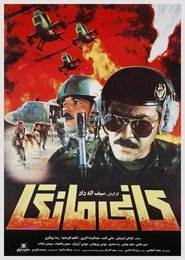
1988
Kani Manga
1988
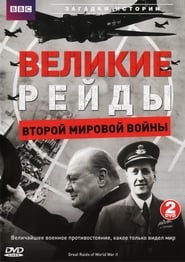
An Iraqi pilot crashes during the Iran-Iraq War over the Kurdish mountains, and two teams race to find him first: the Iranians who want to arrest him, and the Kurds who want to save him from Iranian capture.Great Raids of World War II
2006
star 5Showcases a series of daring raid made by various sections of the British military during World War II. The raids highlighted are "Stopping Hitler's A-Bomb", "Prison Busters", Radar Beam Raiders", "Storm at St. Nazaire", "Cockleshell Raiders" and "Arctic Commando Assaults". Each raid is analyzed, the reasons for it taking place, the planning and execution plus the results and consequences.La Desbandá
2023
La Desbandá
2023
惊沙
2011
惊沙
2011
Heartbreak Ridge
1955
Heartbreak Ridge
1955
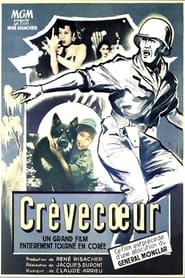
Garcet, a young French officer just out of military school, joins the French Batallion of the United Nations Forces fighting in Korea.The Plot to Kill Hitler
2023
star 7The 20th July 1944. Operation Valkyrie is underway. Conspirators race to change the course of history forever. Will the plot succeed or will Adolf Hitler escape unharmed...once again?Prisoners of Propaganda
1987
star 6In 1943, the Imperial Japanese Secret Service made a film called Calling Australia! to show the "exemplary conditions" under which prisoners of war were kept, and to "soften up" the Australian public for the anticipated occupation of their country by Japanese forces. Prisoners of Propaganda tells why the film was made, and how it came to be forgotten.The Valley Train
1989
The Valley Train
1989
An adolescent boy in a kibbutz of the 1960s. A relationship between the boy and a young kibbutznik who serves in an elite unit. The boy dreams of resuming the train that once passed through the valley. In the background, Israeli wars disrupt life.The Dads 2
2021
The Dads 2
2021
Following the release of their first film, Chad and Jackson (The Dads) find themselves at odds with a nefarious cult known as "The Community." Their only chance is to declare open war against the cult.My Father’s Brothers
2021
My Father’s Brothers
2021
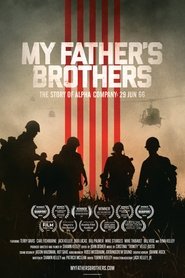
Jack Kelley volunteered for Vietnam. As an army captain, he routinely led his company of 140 men on patrols in the jungles near Biên Hòa. Ill-conceived orders came down from higher command: On June 29, 1966, Capt. Kelley was to spread his platoons 1,000 meters apart in order to cover more area while looking for Vietcong forces. During the patrol, the 3rd platoon stumbled upon an embedded Vietcong main force battalion. Outnumbered by nearly 10 to 1, the platoon was blindsided by a fierce attack. The triple-canopy jungle was dense and the terrain muddy, making rescue all but impossible. The film is a journey to understand what the filmmaker's father and seven survivors went through in 1966, and what they continue to go through today. Some volunteered for the army as teenagers. Others were drafted. Some went back to Vietnam years later with the hope of finding closure and peace.